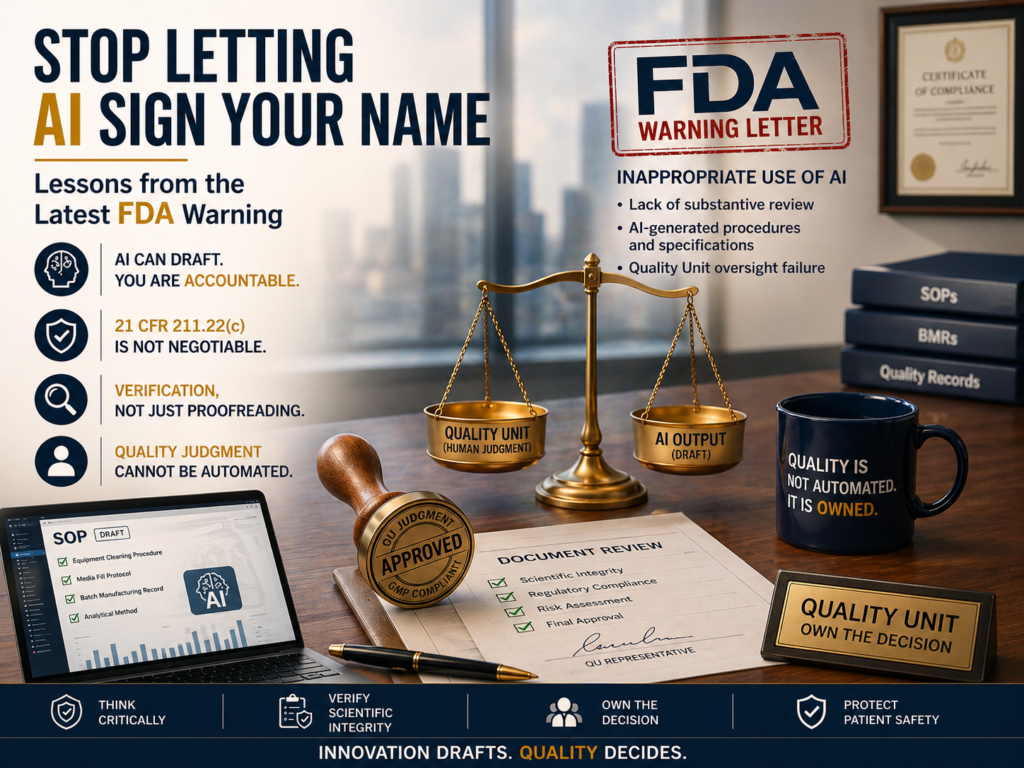
Stop Letting AI Sign Your Name: Lessons from the Latest FDA Warning
When we’re staring preparation of batch manufacturing record (BMRs) or any SOP the AI tool that can “draft” them in seconds.
But the FDA just cleared its throat and the sound should make every Quality Head in the industry sit up a little straighter.
The recent April 2026 warning letter regarding the “Inappropriate Use of AI” isn’t actually a strike against technology. It’s a strike against intellectual laziness. It’s Not About the Tool; It’s About the Authority The regulators didn’t walk into that facility and say,”Stop using AI.” They walked in and saw that the Quality Unit (QU) had checked out. The FDA observed AI-generated procedures and specifications being pushed through with reviews that were “not substantive enough.
AI is incredibly good at looking right, even when it is fundamentally wrong. It can draft a sterility testing procedure that reads like a dream but misses a critical incubation nuance required by your specific product.
21 CFR 211.22(c) Is Not Negotiable:
We often get bogged down in the “newness” of technology, but the regulations are remarkably old-school. 21 CFR 211.22(c) doesn’t care if a human, a robot, or a typewriter created the draft. It care about who owns the decision.
If an auditor asks you to justify a sampling plan and your answer is, “The AI suggested it based on industry standards,” you’ve already lost the audit. A polished AI generated draft is not a defensible GMP decision.
My Rule of Thumb for the Team:
If we’re going to use AI in our workflow, we have to treat it like a brilliant but occasionally delusional assistant.
- Proofreading looks for typos. Verification looks for scientific integrity. We need to do the latter.
- When a QU person representative signs off on an AI-assisted document, they aren’t just saying “this looks okay.” They are saying, “I have verified this against cGMP and I am willing to defend it in a 483 response.”
Conclusion:
Innovation should make us faster, but it shouldn’t make us softer. Use AI to handle the tedious drafting, the formatting and the initial structuring. But when it comes to the actual judgment—the “is this safe for the patient?” part—keep your hands on the wheel.
The FDA isn’t afraid of our computers. They’re afraid we’ve stopped using our brains. Let’s prove them wrong.