- OBJECTIVE
This document covers the Microbial Culture Maintenance SOP | Receipt, Storage & Revival and related steps.
- SCOPE
This Microbial Culture Maintenance SOP | Receipt, Storage & Revival governs Receipt, Storage, Reconciliation, Revival, Preparation, and Maintenance of Microbial Cultures in the Microbiology Laboratory of Pharma Micro Hub Pvt Ltd.
- RESPONSIBILITY
- Microbiologist is responsible for the Receipt, Storage, Reconciliation, Revival, Preparation and Maintenance of Microbial Cultures.
- Head – Microbiology or designee is responsible for the overall compliance of this SOP.
- PROCEDURE
- Precautions:
- Handle the culture strains in Bio-safety cabinet.
- Ensure the personnel handling the culture strains are adequately trained on Operation of bio-safety and aseptic techniques.
- In case of any spillage of microbial strains or culture suspension, clean the biosafety cabinet with the sporicidal disinfectant.
- Wear nose mask and sterile hand gloves before starting analysis.
- Do not use the cultures after the expiry date given by the supplier.
- Ensure Biosafety cabinet is cleaned with sporicidal disinfectant before usage.
- Procurement and Receipt:
- Procure the lyophilized Reference Strains from ATCC (American Type Culture Collection) or its equivalent strains as per the requirement.
- Upon receipt, check the correctness of the label information of each of the reference strains. In case of any discrepancy, notify the Head Microbiology/ Designee and the Supplier. Do not use the strain.
- Ensure the CoA (Certificate of Analysis) received along with the culture strains. Check the CoA for the details like Name of the Strain, strain Number, passage number, Storage Conditions and Date of Expiration. COA shall be reviewed, signed as a proof of review and filed.
- If the physical condition of the box and packing are satisfactory, then only accept the culture and transfer to Microbiology department. If it is not satisfactory send back to the vendor.
- Label the received culture as per the Culture Receipt Label.
- Enter the receipt details of cultures in the culture stock card.
- Labeling and Storage:
- Store all the lyophilized cultures in the refrigerator at 2-8°C or as per the Vendor’s recommendation.
- Precautions:
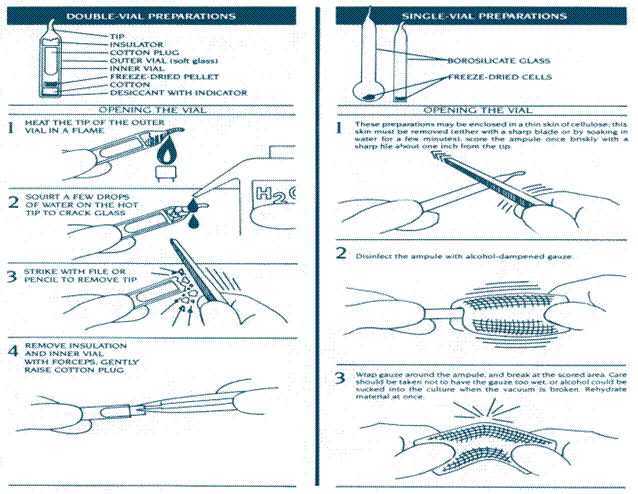
- Revival of master culture (Lyophilized form): Revival of culture received in double vial preparation:Heat the vial outer layer tip in flame.Add a few drops of water on the flame exposed side to crack the glass.Strike the glass with sterile forceps or sterile scissors.Remove the insulation and inner vial, with sterile forceps and gently raise the cotton plug.For further procedure for preparation refer point No.5.5.Revival of culture received in single vial preparation:Open the culture pack and sanitize the ampule outer surface with wet mop moistened with sterile 70% v/v IPA and break open the ampule with sterile forceps or sterile scissors.Wrap thick sterile cotton wool (or gauge) around the ampule and break the ampule carefully. Care should be taken while opening the ampule as hasty opening will release fine particles of dried organisms into the air.Take the sterile forceps and aseptically remove the pointed top of the ampule and cotton plug.Transfer the cotton and broken part of ampule/Vial in the beaker containing sporicidal disinfectant.For further procedure for preparation refer point No.5.5.
- Preparation of Cryo vials :
- Allow the freeze-dried strains to attain room temperature before revival.Disinfect the outer surfaces of the lyophilized culture
- /vials using the 70%v/v Iso-propyl alcohol.In case of vials, open the Aluminum seal first followed by the rubber stopper aseptically.In case of the
- , break open the unit follow the instructions as mentioned in 5.4.Aseptically add 0.3 mL of sterile
- casein digest broth and mix well.Take a loop full of culture from above and streak onto agar plate containing
- casein digest agar. Transfer the whole mixture to a sterile test tube containing 20 mL of
- casein digest broth. The agar plate shall be used for purity check and the broth is used as a backup in case the streaked plate does not show growth. Incubate both SCDB and SCDA at 30-35°C for 24 – 48 hrs. This is considered as the first transfer (T1). Check the agar plate for purity by Gram staining as per the SOP. Pick up isolated colony and perform gram staining followed by species level identification. Simultaneously pick isolated colony and inoculate into 100mL of the
- casein digest medium with 10 % glycerol. Incubate the tube at 30-35°C for 24 – 48 hrs. This is the second transfer. (T2). Document the details in Culture Maintenance Record. In case of anaerobes, incubate the plate in anaerobic jar to maintain anaerobic conditions.In case of molds, use SDB for enrichment, use SDA for sub culturing further incubate the plates at 20-25°C for 3 to 5 days.In case of Fungal Streak loop full of culture on to the Agar Slant and further incubate the slants at 20-25°C for 3 to 5 days.Post completion of incubation period, verify the visual growth and transfer 1 mL of culture into sterile cryovials. Label the vials as per the Cryovial Label and store at -30°C or below.During the usage of cryovials, purity of the culture to be verified by streaking a loop full of culture from cryovial
- on to suitable media.Verify the purity of the culture by staining and check the plate for the pure culture. If mixed colonies found on the plate, then subject the colonies for species level identification for further confirmation.
- If cryovial found contaminated discard the entire lot and prepare freshly.
- Preparation of Cryo vials :
Note: The frozen cryovials should not be used for more than one year.
- Cryovial preparation for In-house isolates:
- Take the colony from the master plate and streak on to SCDA/R2A plate (Use R2A for water isolates) (consider this as T1 passage) and subject it for identification.Post completion of identification, take an isolated colony from T1 plate and streak on to the SCDA/R2A plate (Use R2A for water isolates) and inoculate a loop full of culture in to sterile 100 mL SCDM with 10 % glycerol (consider this as T2 passage). Incubate both tube and plate at 30-35°C for 24 to 48 hrs. Agar plate shall be used for purity check and broth tube shall be further used for cryovial preparation. In case of molds, use SDB for enrichment, use SDA for sub culturing further incubate the plates at 20-25°C for 3 to 5 days.In case of Fungal Streak loop full of culture on to the Agar Slant and further incubate the slants at 20-25°C for 3 to 5 days.Post completion of incubation period, verify the visual growth and transfer 1 mL of culture into sterile cryovials. Label the vials as per the Cryovial Label and store at -30°C or below.During the usage of cryovials, purity of the culture to be verified by streaking a loop full of culture from cryovial
- on to suitable media.Verify the purity of the culture by staining and check the plate for the pure culture. If mixed colonies found on the plate, then subject the colonies for species level identification for further confirmation.
- If cryovial found contaminated discard the entire lot and prepare freshly.
Note: The frozen cryovials should not be used for more than one year.
- Determination of inoculum concentration.
- Take 0.1 mL or loop full of culture from the cryovials (T2 cultures) and inoculate in to the 10 mL SCDM (for enrichment) and streak a loop full of culture on to
- casein digest agar plate (for purity check, in case of cryovial). Use SDB for yeast and molds.Document the purity check and gram staining details in culture maintenance record.Incubate bacterial culture at 30-35°C for 18 – 24 hrs and yeast & mold cultures at 20-25°C for 24- 48 hrs.
- Determine the inoculum concentration to obtain NMT 100 CFU/0.1 mL by making serial dilutions from the above enrichment tube. Take 1 mL from the enrichment tube and add into 9 mL of sterile saline solution (10-1 dilution) likewise do the serial dilution up to 10-8.
| Dilution Level | Volume of sterile saline | Volume of culture |
| 10-1 | 9 mL | 1 mL from enrichment tube |
| 10-2 | 9 mL | 1 mL from 10-1 |
| 10-3 | 9 mL | 1 mL from 10-2 |
| 10-4 | 9 mL | 1 mL from 10-3 |
| 10-5 | 9 mL | 1 mL from 10-4 |
| 10-6 | 9 mL | 1 mL from 10-5 |
| 10-7 | 9 mL | 1 mL from 10-6 |
| 10-8 | 9 mL | 1 mL from 10-7 |
- Plate out the dilutions from 10-4 to 10-7 (or to obtain NMT 100 cfu) in duplicates using Soybean casein digest agar.
Note: Plating can be done by pour plate method using 1 mL of above suspension or spread plate method by using 0.1 mL of above suspension.
- Use R2A media for water isolates and use SDA in case of yeast & molds.
- Incubate the plates at 30-35°C for 18 – 72 hrs for bacteria and at 20-25°C for 3 to 5 days for yeast & molds. Document the details in Record for Determination of inoculum concentration.
- Select a suspension of NMT 100 CFU/0.1 mL for routine laboratory use and label the dilutions as per the culture suspension label.
- Assign the reference number as mentioned below to each inoculum determination.
For example: IS/YY/0001
IS-Inoculum Suspension
YY denotes last two digits of current year.
NNNN denotes serial number starting from 0001
- Preserve the in-house suspension (NMT 100 CFU / 0.1 mL) of each organism at 2-8°C for not more than 5 days from the date of standardization.
Note: The frozen cryovials should not be used for more than one year.
- GLOSSARY
Nil
- ABBREVIATIONS
- °C : Degree centigradeCFU : Colony Forming UnitCOA : Certificate of Analysis.hrs : Hours.MB : MicrobiologymL : mili litterNMT : Not More ThanNLT : Not Less ThanQA : Quality AssuranceSCDA :
- Casein Digest AgarSCDB :
- Casein Digest MediumSDA : Sabouraud Dextrose AgarSDB : Sabouraud Dextrose Broth
- SOP : Standard Operating Procedure
- FORMAT(S)
| S.No. | Formats |
| 1 | Culture maintenance Record |
| 2 | Record of Determination of Inoculum Concentration |
| 3 | Cryovial Label |
| 4 | Culture Suspension Label |
| 5 | Culture Receipt Label |
| 6 | Culture Stock card |
- REFERENCES
- Handling of Culture and Media Spillage in Microbiology Laboratory
- Procedure for Isolation Identification and Handling of Isolates.
- CHANGE HISTORY
- New SOP
END OF DOCUMENT
| Name of the Culture | Date of Receipt/ Identification | ||
| Source | Expiry Date | ||
| ATCC/ Equivalent ATCC No./Isolate No. | |||
| Total Number of Vials received | |||
FIRST TRANSFER (T1) – REHYDRATION OF LYOPHILISED CULTURE
| Media for Rehydration | Lot No./Expiry Date | ||
| Quantity of Media used | |||
| Media for purity check | Lot No./Expiry Date | ||
| Incubation Temperature | Incubator ID | ||
| Incubation start date/time | Done By(Sign/Date) | ||
| Incubation end date/time | Observed By (Sign/Date) | ||
| Observation | Growth/No growth | Gram Stain | |
| Reviewed By(Sign/Date): | |||
OBSERVATION OF COLONY CHARACTERISTICS:
| Colour : | |||
| S.No | Morphology | Observation | |
| 1 | Shape | ||
| a. | Circular |  | |
| b. | Irregular |  | |
| c. | Filamentous | | |
| d. | Rhizoid | | |
| e | Spindle |  | |
| 2. | Elevation | ||||||
| a. | Flat |  | |||||
| b. | Raised |  | |||||
| c. | Umbonate |  | |||||
| d. | Crateriform |  | |||||
| e. | Convex |  | |||||
| f. | Pulvinate |  | |||||
| 3. | Margin | ||||||
| a. | Entire |  | |||||
| b. | Undulate |  | |||||
| c. | Lobate |  | |||||
| d. | Curled |  | |||||
| e. | Filiform |  | |||||
| 4. | Size | ||||||
| a. | Punctiform |  | |||||
| b. | Small |  | |||||
| c. | Medium |  | |||||
| d. | Large |  | |||||
| 5. | Surface | ||||||
| a. | Smooth | ||||||
| b. | Rough | ||||||
| c. | Wrinkled | ||||||
| d. | Dry powder | ||||||
| Done by (Sign/Date) | Reviewed by (Sign/Date) | ||||||
PURITY CHECK BY ID SYSTEM
Name of the Organism: ___________________________
Instrument used for Identification/Instrument ID.: _____________________________
Done by: Reviewed by:
Sign/date: Sign/date:
SECOND TRANSFER (T2) FOR CRYOVIAL PREPARATION
| Name of the Media | Lot No./Expiry Date | |||
| Quantity of Media used for Cryovial Preparation | ||||
| Incubation Temperature | Incubator ID | |||
| Incubation start date | Done By (Sign/Date) | |||
| Incubation end date | Observation | Growth/No growth | ||
| No. of Cryovials Prepared | ||||
| Date Of Preparation | Valid Up To | |||
| Prepared by (Sign/Date) | Reviewed by (Sign/Date) | |||
| Cryovial No. | Media Used for purity check | Media Lot No. | Done by | Observation | Gram stain | Observed by | Reviewed by |
- Sub culturing Details:
| Date of sub culturing | Date of observation | ||
| Name of the organism | Inoculum ID number | ||
| Enrichment media Name | Lot number | ||
| Source | Valid up to | ||
| Incubation start date & time | Incubation end date & time |
Added ______________ of culture from cryovial / plate and incubated at _____________ temperature
and growth observed / not observed.
Done by: Observed by:
Sign & Date Sign & Date
- Culture Suspension Details:
| Date of serial dilution | Date of release | ||
| Media used | Lot No & Exp date | ||
| Diluent used | Lot No & valid up to | ||
| Incubation start date & time | Incubation end date & time | ||
| Analyzed by (Sign & Date) | |||
| Dilution level | Plate count | Average | Observed by | |
| Plate-1 | Plate-2 | |||
Selected dilution & Concentration: _______________________
Remarks:
Reviewed by:
Sign & Date
| CRYOVIAL LABEL | |
| Name of Organism | |
| Date of Preparation | |
| Vial Number | |
| Expiry Date | |
| Prepared by | |
| Culture Suspension | |
| Name of Organism | |
| Culture Suspension Ref. No: | |
| Dilution/Concentration | |
| Valid Up to | |
| Storage condition | 2-8°C |
| Prepared By | |
| CULTURE RECEIPT LABEL | |
| Name of Organism | |
| Strain Number | |
| Transfer /Passage Number | |
| Number of vials | |
| Date of Receipt | |
| Storage Condition | |
| Received by | |
| Name of Organism: | Strain No: | ||
| Date of Receipt | Quantity Received | ||
| Storage Temperature | Expiry Date: | ||
| Received By (Sign & Date) | |||
| Date of Issuance | Used Quantity | Used For | Balance Quantity | Used By | Reviewed By | Remarks |